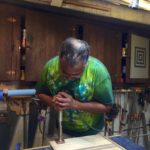
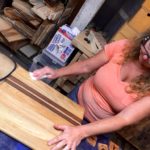
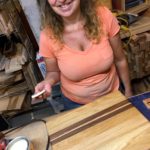
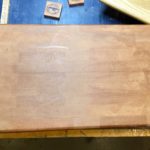
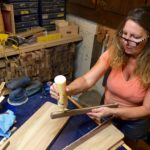
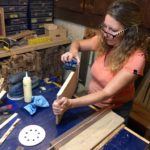
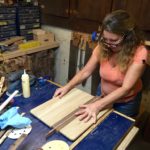
Today was a long and tiring day. Both of us spent the morning completing some necessary tool maintenance. And then we got to have fun! We spent this afternoon building a couple of prototypes we plan to place in our Etsy Store — very soon! The first – an end grain “butcher block” cutting board and second, a serving board/platter.
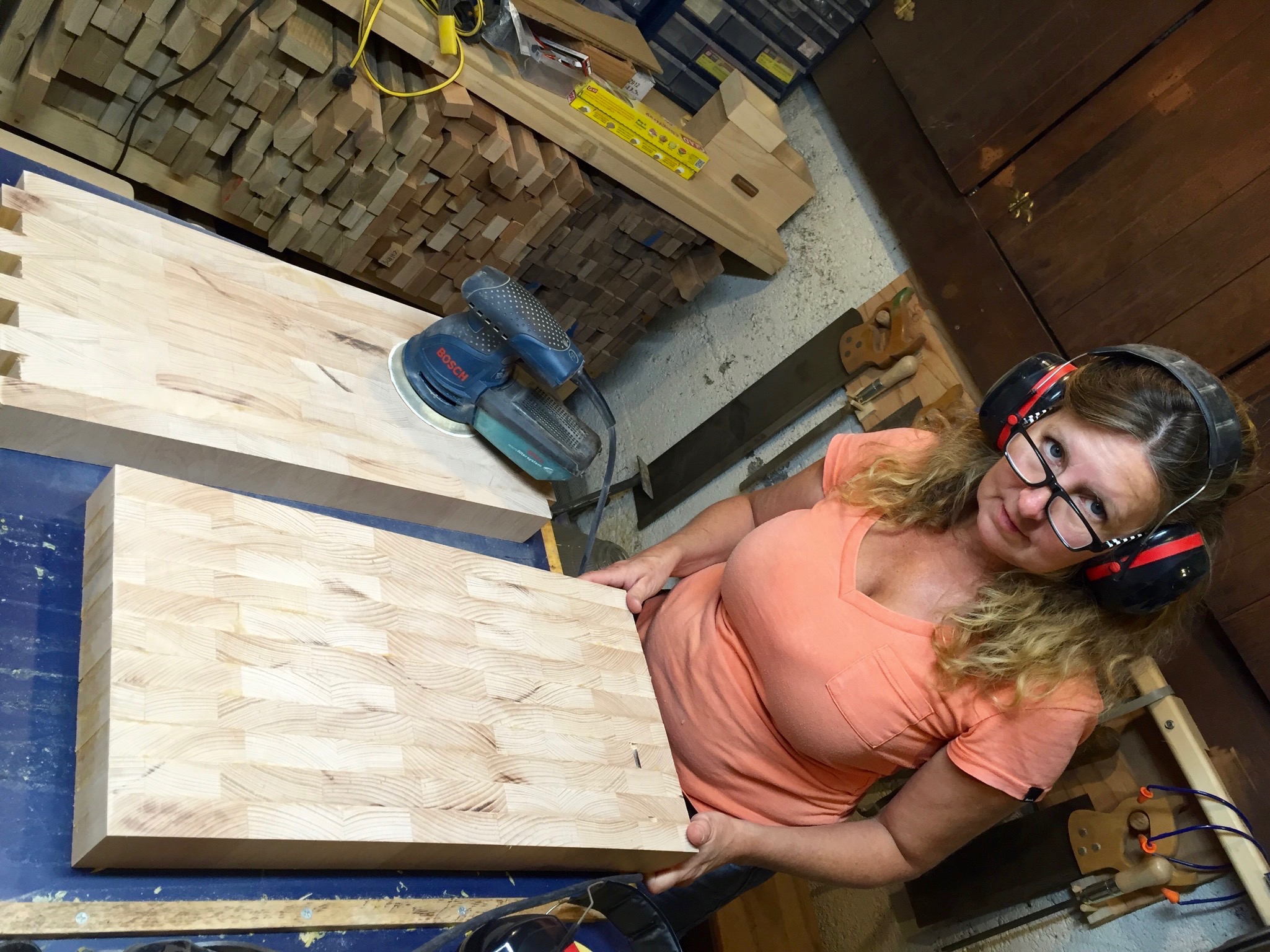
Butcher Block cutting boards are “de rigeur” (i.e. necessary) if you are serious about cooking. They expose the end grain rather than long grain unlike most of the non-plastic cutting boards one finds. It’s sort of like a dart board. The fibers part to absorb the cutting edge allowing it to stay sharp longer. If you ever go by a traditional butcher shop, you’ll will probably see them cutting on either an end grain cutting board or the cross section of a tree stump — depending on how traditional they are and how long they have been in business. End grain butcher block cutting boards are the modern equivalent of the original tree stump. They can be quite beautiful. And now, we are making some.
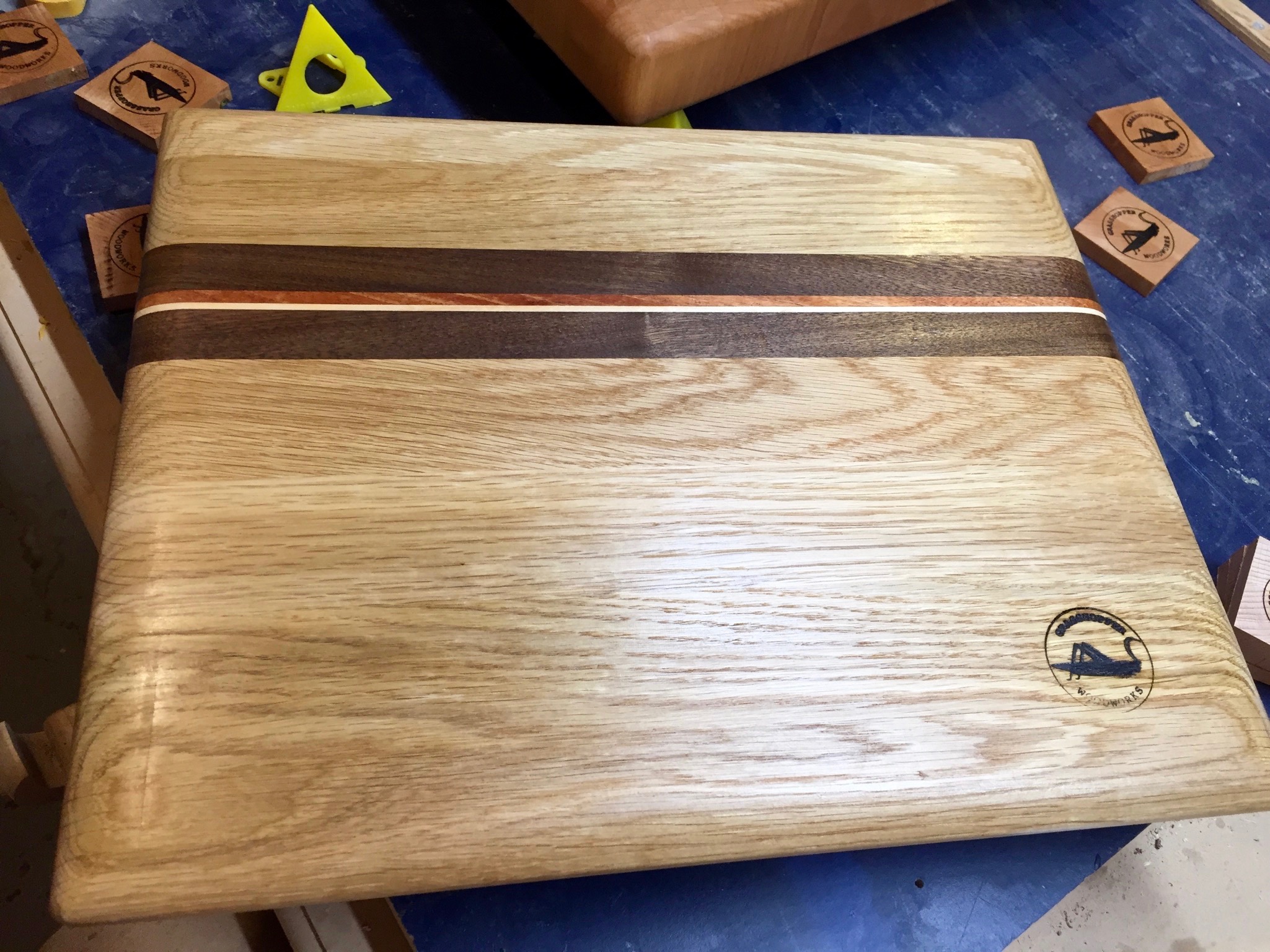
The other item we started making is a serving platter. In this case, it’s a wooden board with feet. Since we tend to associate platters with parties and special occasions, we are making these decorative while maintaining the resilience and utility of a cutting board. The easiest decoration is to put together a straight lamination of different/contrasting woods that please the eye. Lots of people do this. Some to great excess.
We are experimenting with simple laminations that are curved rather than linear to add visual interest.
We’ve made two variations of each of the above items. Two of the creations have been spoken for. The other two will go into our Etsy Store to start spooling it up. If you’ve read this far, please visit our store and “favorite” it. This will greatly assist to develop our online presence.
Lisa contemplating one of our end grain cutting boards
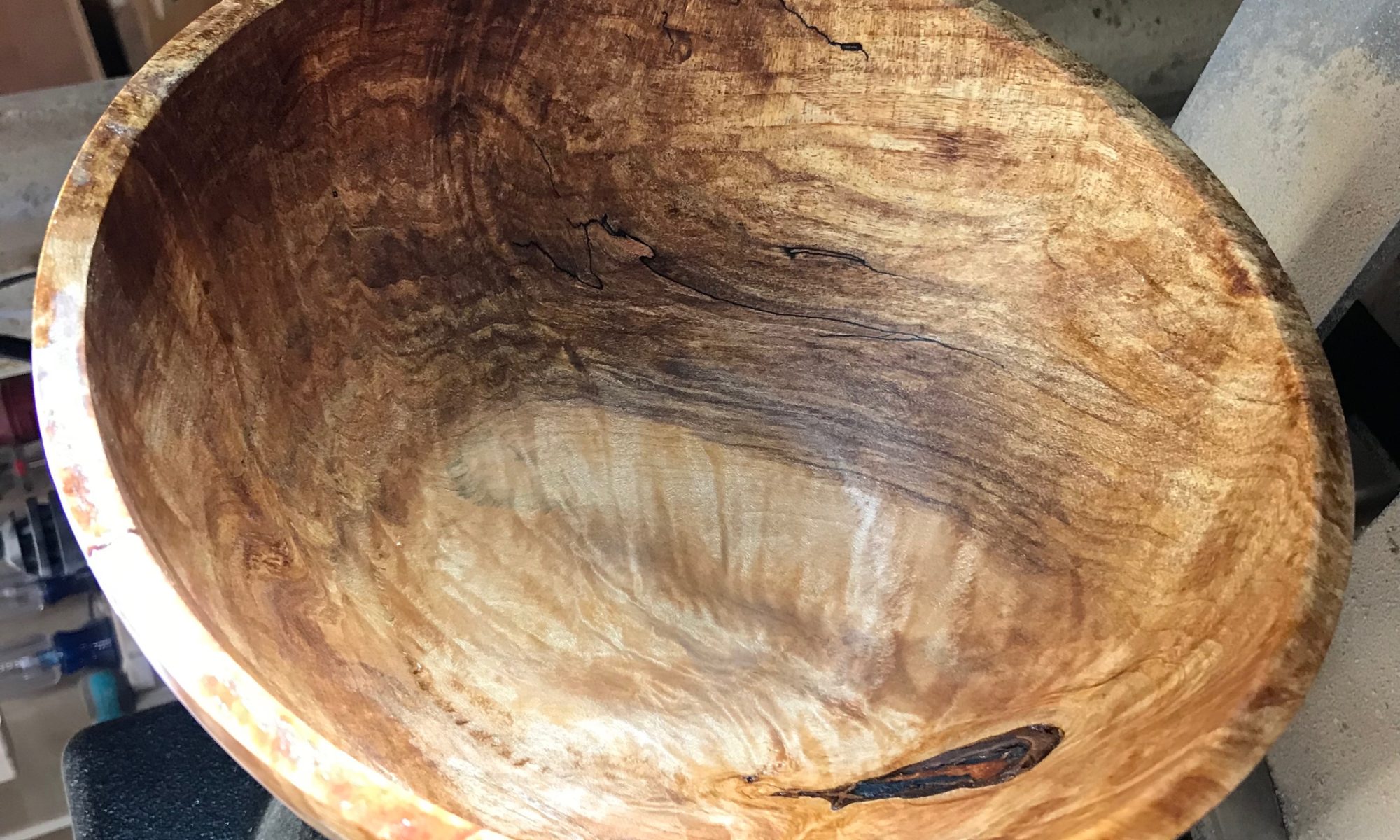
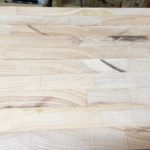
Close up of the grain on one of the boards
Add the glue …
Spread the glue …
Assemble the board
Before
Let us know if you find what we are creating interesting. We love feedback!
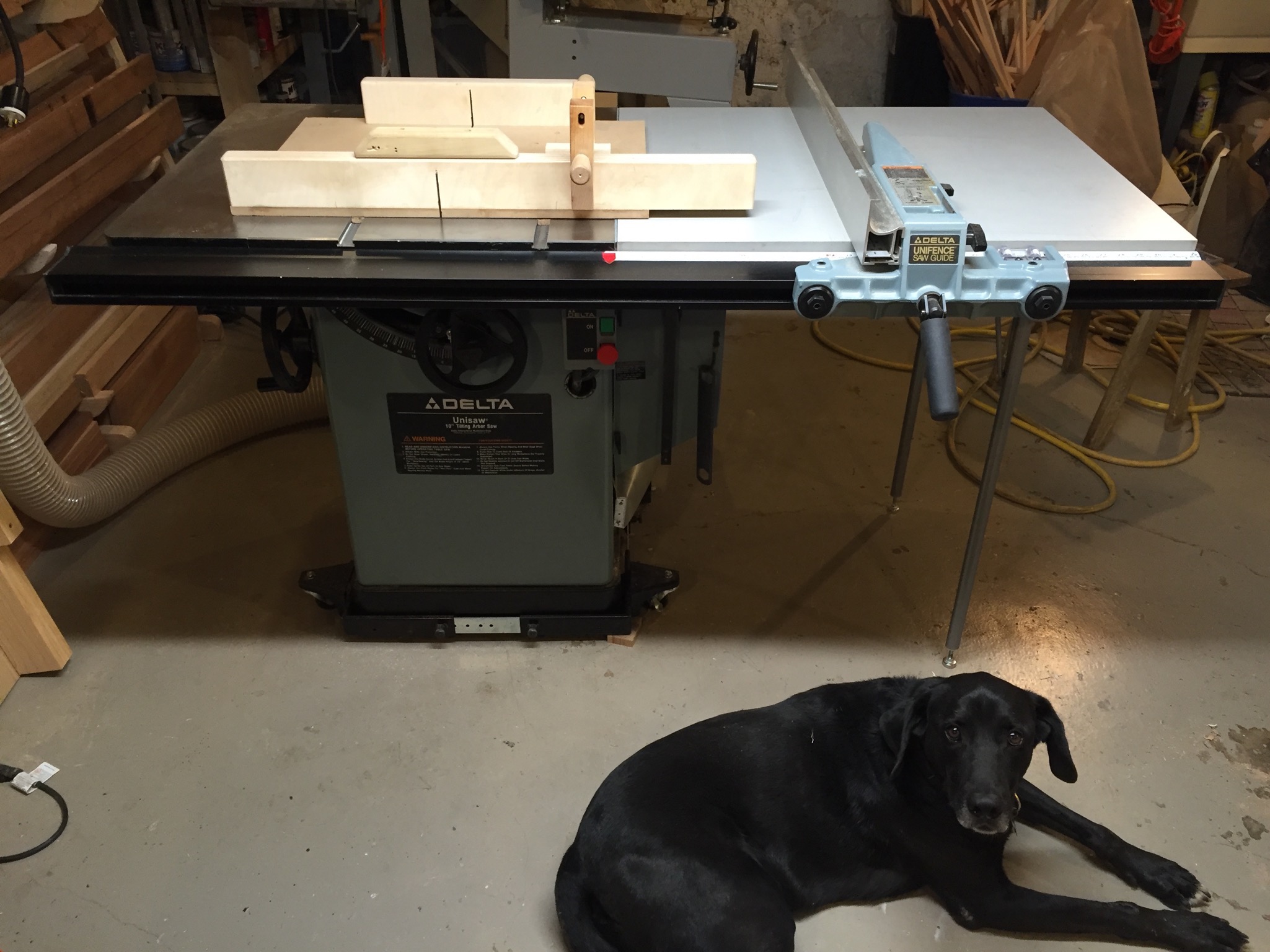
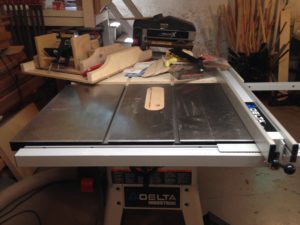
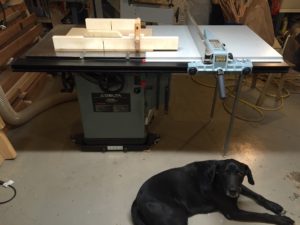
A table saw is the heart of most small woodshops. This weekend we decided it was time for the heart transplant. We replaced our trusty Delta Contractor-style saw with a more powerful Cabinet saw.
Old Delta Contractor Saw
“Why? ” you ask, would we do this when we had just managed to restore our shop back on an even keel after replacing our dust collection system the previous week. The simple answer is we needed a more powerful saw.
Over the past few months we’ve been moving from working with plywood and softer woods like Pine, Alder, and Poplar, to woods like Walnut, Cherry, Maple, and Beech. These woods are much harder than the previous ones. They are also more sensitive to the feed rate, or speed at which they are cut. Too slow a feed rate, and the wood gets scorched and potentially warped by friction from the blade. Too fast a feed rate and the saw chokes. Both situations are dangerous as they can result in “kick back” in which the piece of wood is flung back, bruising the operator at best, and impaling them at worst. These are technical details that one would learn in a formal apprenticeship, but are hard lessons in the youtube DIY world.
Since neither of us are enthusiastic about being whacked, or even worse skewered, by wooden projectiles of our own creation. We decided that an upgrade was in order. Fortuitously, a member of the Guild of Oregon Wood Workers (to which we belong) was closing his shop and selling his saw, so we took the opportunity and purchased it.
Our New (to us) Cabinet Saw
Integrating the new saw entailed selling our old one, liberating it from the confines of the basement, and then moving the new one in. This is no easy feat. We have our shop set up in our basement. The stairs to the basement are quite narrow and the saws are heavy and unwieldy. Once again, as luck would have it, the new owners of our trusty contractor saw helped us to both move the old saw out and bring the new saw in. This was super helpful as there was a good chance that if we tried it ourselves, one of us would have got squished.
The reason replacing the saw feels like heart surgery is our small shop became a disastrous and dangerous mess. Lots of stuff needed to be re arranged to accommodate the new beastie. Wood and partial projects were precariously balanced on each other temporarily. Our out feed table, which supports longer pieces of work, and provided storage for additional saw accessories went to the new owner. All of the sleds and jigs we had previously made needed to be rebuilt. It’s an absolute mess. That’s the downside.
The upside is we have a more capable tool with much better dust containment. Even though we need to rebuild our sleds and jigs, we can do so faster, more accurately, and safely, while making small improvements based on experience we have acquired.
UPDATE: We are back on line! The saw’s been calibrated. The basic sleds have been rebuilt. The Unisaw saw works like a dream.
Stay tuned. We can make sawdust again. We may have product to show soon!?!
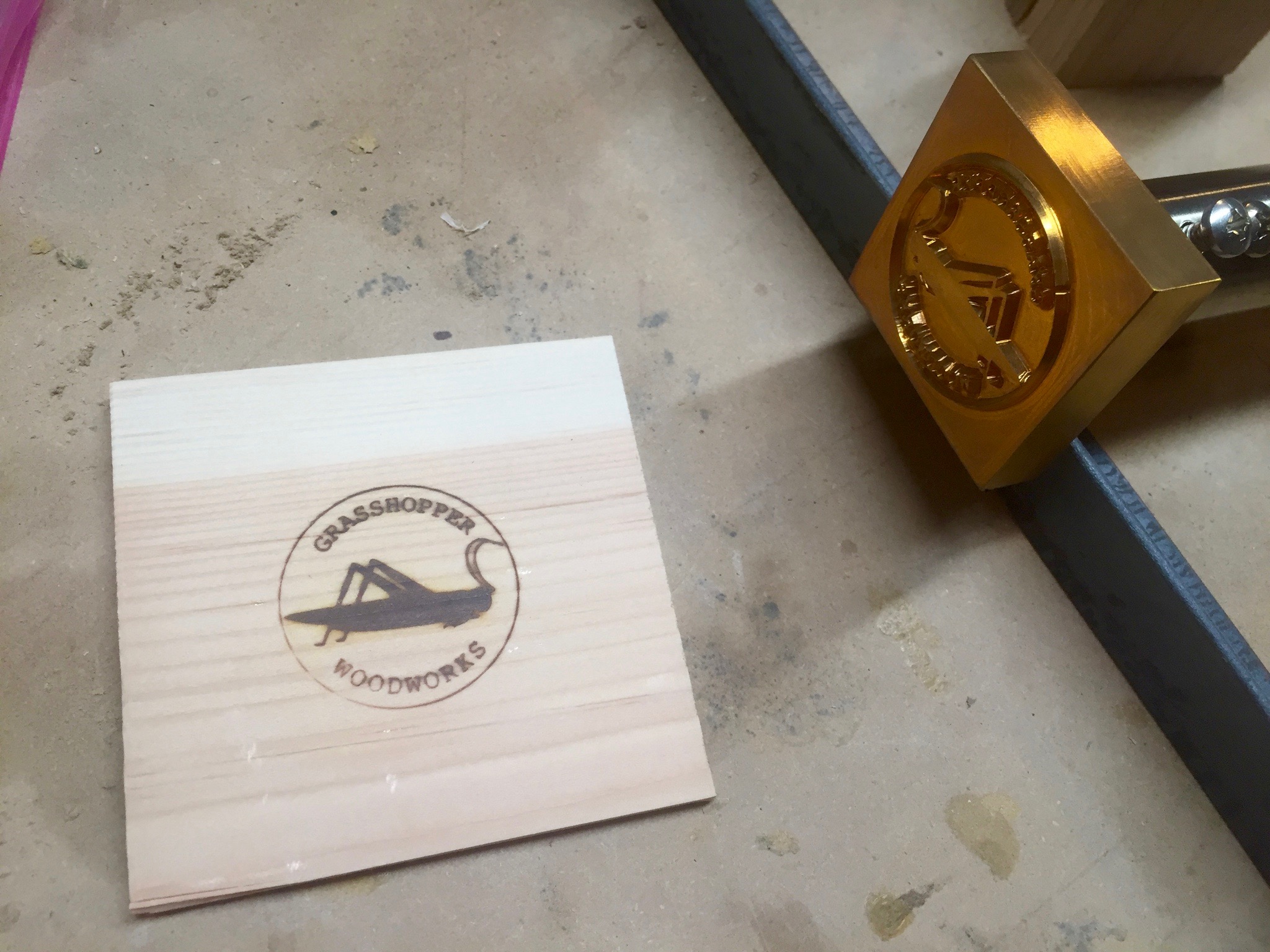
A large part of building a small business appears to be about branding. Perhaps we’ve misunderstood the memo. We recently purchased and received a branding iron with which to brand our products.
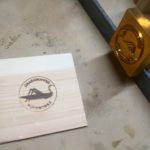
Here are pictures of our first attempts at branding. We love our brand and hope you do too.
Plugged in and warming up
Lisa making it count — our first impression!
Our brand. It’s official.
Note: Don't heat your branding iron on a wooden stand -- for obvious reasons.
      The shaft got a lot hotter than we expected and scorched the wood. Duh.
Hello World! In case you followed the “Harley, Lisa, and Ajit” story on sailingpearl.com, and have been wondering what we’ve been up to, here’s the latest.
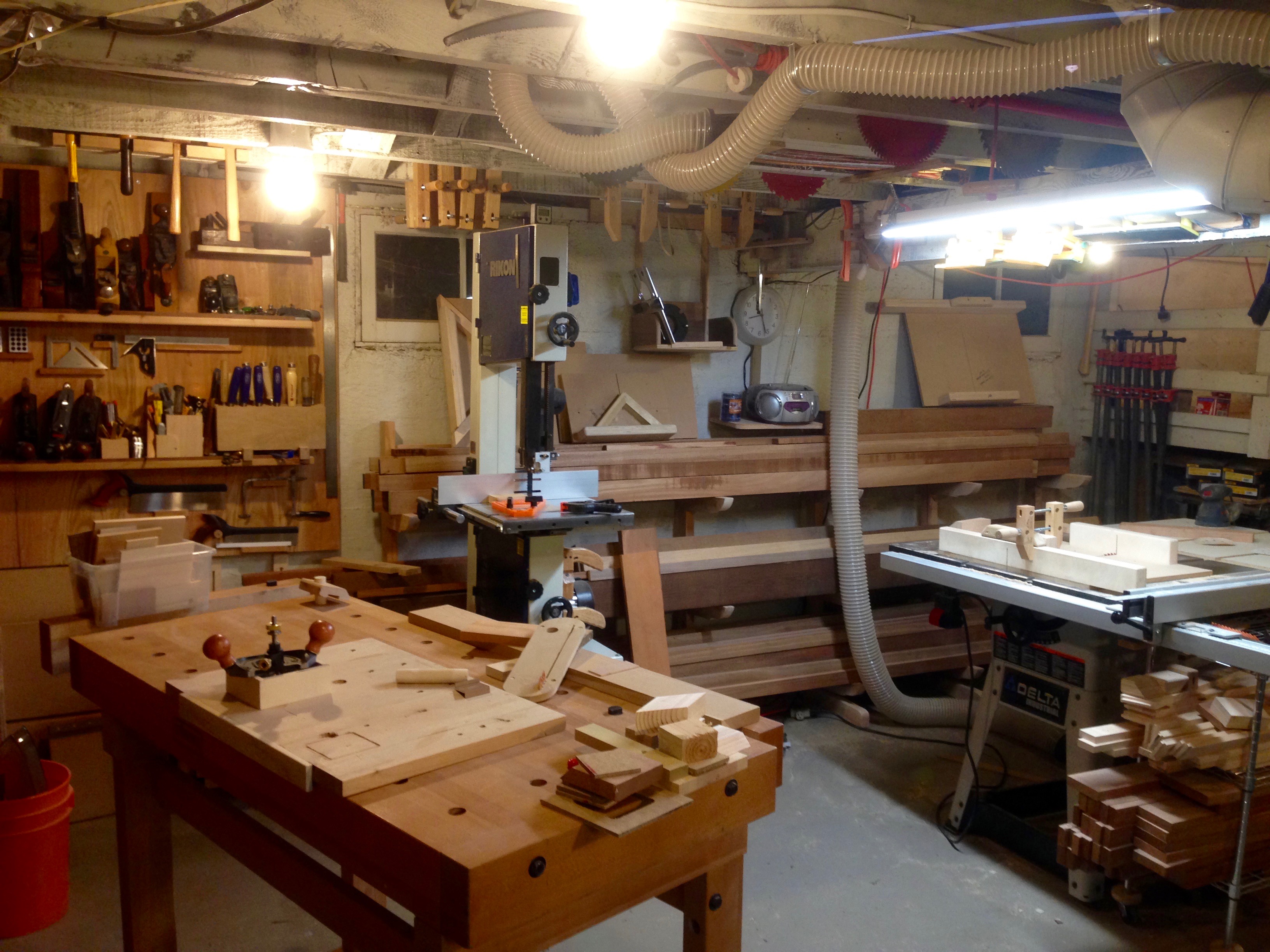
The three of us have spent the past several months in Portland, OR. Initially, we were exploring the possibility of building little robots to automate routine manufacturing tasks for small producers. In doing so, however, we encountered a minor problem: we had no experience manufacturing anything. So, we decided to launch a little manufacturing company out of our basement that produces solid wood furniture and accessories. This seemed like a better first step than trying to solve problems that we didn’t quite understand.
So, what are we making? Our first products are simple ideas: a cradle for charging phones when traveling; floating shelves, serving platters, bud vases, and a couple of other things we are still debating — like candelabras and (desk) organizers. Some of what we have made has been released into the wild already with friends and family.
Why these things, you may ask. All these items are items we have needed or wanted. We figured what we came up with for us may work for other people as well. They also build fundamental skills like cutting straight, making perfect corners, making dead flat surfaces, making regular and irregular polygon shapes, and most importantly finishing. These are all essential skills for making larger items like tables, chairs, and other furniture — that we will get to soon!
The smaller stuff also helps us with the business aspects of this project, sourcing and storing material, doing a production run of something, shipping, marketing, the list goes on. Having acquired most of our tools and honing our basic skills, we are now ready to set up our media presence and ramp up production.
Please comment, make suggestions, tell us we are crazy, whatever! Stay tuned. More to come.